
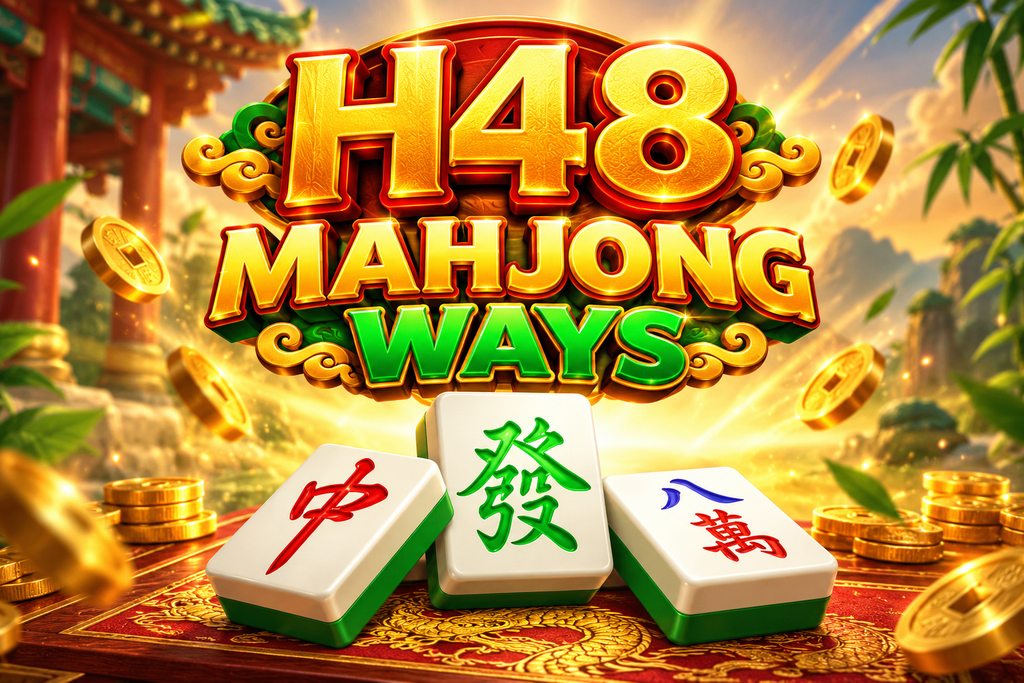
A Game World Built Around Ancient Mahjong Tiles
Three beautifully crafted Mahjong tiles rest beneath a magnificent golden title. Behind them, traditional Chinese architecture, bamboo leaves, floating coins, and warm sunlight create an atmosphere inspired by classical Asian aesthetics.
This distinctive presentation forms the visual identity of H48 Mahjong Ways, a Mahjong-themed gaming experience that combines traditional tile imagery with the colorful design of modern digital entertainment.
Unlike conventional fruit-themed slots, Mahjong Ways draws inspiration from a recognizable tabletop game. Its symbols resemble traditional Mahjong pieces, while golden decorations and green accents give the design a luxurious appearance.
The most interesting aspect of this theme is the relationship between familiar cultural symbols and modern game mechanics.
Although Mahjong Ways borrows its visual identity from traditional Mahjong, its slot-style gameplay should not be confused with the strategic four-player tabletop game.
Why the Golden Background Matters
Gold dominates the image, appearing in the lettering, coins, decorative frames, and sunlight.
This color creates a strong visual connection between the Mahjong tiles and the surrounding environment.
Meanwhile, the green bamboo leaves and traditional buildings prevent the design from becoming visually repetitive.
The result is a recognizable atmosphere that communicates the Mahjong theme without requiring numerous decorative icons.
Decoding the Three Featured Mahjong Tiles
The promotional image places three Mahjong tiles directly beneath the title.
Each tile features a different symbol, creating a visual reference to traditional Chinese Mahjong.
Understanding their cultural background adds another layer of interest to the game’s design.
The Green Fa Tile: A Symbol of Prosperity
The central tile features the Chinese character 發, commonly associated with the Green Dragon tile in traditional Mahjong.
The character is connected with meanings related to prosperity and development in certain Chinese-language contexts.
Its green appearance makes it particularly noticeable against the white tile surface.
In Mahjong-themed digital games, this symbol may appear as part of the regular symbol collection or have a specific function depending on the game’s rules.
However, its cultural meaning does not automatically make it the highest-paying symbol.
The Red Zhong Tile: A Distinctive Mahjong Icon
The tile on the left displays the character 中, traditionally associated with the Red Dragon tile.
Its red color creates a strong contrast against the green edges and white background.
The character is one of the recognizable honor tiles in traditional Mahjong.
Within a digital slot adaptation, its actual payment value depends on the game’s paytable rather than its traditional significance.
The Character-Suit Tile: A Link to Traditional Mahjong
The tile on the right resembles a character-suit Mahjong tile.
Traditional Mahjong character tiles typically display Chinese numerals and the character 萬, representing a numbered suit.
This symbol category helps connect the game’s visual design with the original tabletop tradition.
The exact symbols used in the playable version should be verified through the game’s information menu.
| Featured Tile | Traditional Association | Visual Identity |
|---|---|---|
| Green Fa | Green Dragon | Green Chinese character |
| Red Zhong | Red Dragon | Red Chinese character |
| Character-suit tile | Numbered Mahjong suit | Chinese numeral and suit markings |
These visual associations explain the theme rather than establishing official payout values.
Mahjong Ways vs. Traditional Mahjong: Two Different Experiences
A common misunderstanding is that Mahjong-themed slot games use the same rules as traditional Mahjong.
In reality, the two experiences can be substantially different.
Traditional Mahjong Relies on Player Decisions
Traditional Mahjong is a multiplayer tile game involving drawing, discarding, and forming combinations.
Players must consider their available tiles, opponents’ actions, and possible winning hands.
Strategy and decision-making are central to the experience.
Mahjong Ways Uses Digital Slot Mechanics
Mahjong Ways-style slot games generally focus on symbol combinations generated through a digital gaming system.
Rather than selecting and discarding tiles strategically, players interact with a slot interface that determines outcomes according to its programmed rules.
The difference can be summarized as follows:
| Feature | Traditional Mahjong | Mahjong-Themed Slot |
|---|---|---|
| Main objective | Complete a valid Mahjong hand | Form qualifying symbol combinations |
| Player decisions | Strategic tile selection | Bet and control settings |
| Number of participants | Commonly four | Usually individual |
| Outcome system | Rules, skill, and tile distribution | Game-defined random outcomes |
| Payment system | Depends on the tabletop format | Determined by the slot paytable |
Understanding this distinction prevents players from assuming that traditional Mahjong strategies can influence slot results.
The Cascading Reel Mechanic: Understanding the Chain Reaction
One of the most recognizable features associated with the Mahjong Ways series is the cascading symbol system.
In games that use this mechanism, qualifying combinations can cause certain symbols to disappear, allowing new symbols to occupy their positions.
This creates the possibility of multiple evaluations during a single paid spin.
However, the exact cascading rules and availability of this feature must be checked in the specific version offered through H48.
How a Cascade Typically Works
A cascading sequence generally follows a simple process.
- The reels generate an initial arrangement of symbols.
- The system evaluates the arrangement against the paytable.
- Symbols involved in qualifying combinations may disappear.
- Replacement symbols enter the available positions.
- The system evaluates the new arrangement.
- The sequence ends when the applicable conditions are no longer met.
The precise order and conditions depend on the game’s design.
Why Cascades Do Not Guarantee Additional Wins
A cascade can create another opportunity for a qualifying combination, but it does not guarantee that one will occur.
Replacement symbols are governed by the game’s mechanics.
Players should not assume that several cascades in one spin indicate that the following spin will be more profitable.
Each new paid spin should be understood according to the game’s random outcome system.
Golden Symbols and Their Potential Role
Golden tiles are another recognizable visual element in Mahjong-inspired slot designs.
They can make certain positions or symbols appear more prominent during gameplay.
In some Mahjong Ways implementations, special golden symbols interact with the cascading mechanic.
However, the conditions under which golden symbols appear or transform depend on the specific game version.
Are Golden Tiles Automatically Wild Symbols?
Not necessarily.
A golden symbol may have a transformation rule, special visual effect, or another function defined by the game.
Players should not assume that every golden tile acts as a Wild.
The correct interpretation comes from the information screen and paytable.
Why Symbol Transformation Matters
Symbol transformations can change how combinations are evaluated during a cascade.
For example, if a game converts certain symbols into Wilds after a qualifying event, those Wilds may contribute to subsequent combinations.
This is a general explanation of a possible mechanism, not a claim that every version of H48 Mahjong Ways follows the same rules.
Understanding Multipliers Without Misreading the Numbers
Multipliers are among the most discussed features of modern slot games.
They can increase the value of a qualifying payout when the required conditions are met.
However, their actual impact depends on how the game applies them.
A Simple Multiplier Example
Suppose a qualifying combination produces a base payout of 10 credits.
If an applicable 3x multiplier is used, the resulting payout would be:
10 × 3 = 30 credits.
This example illustrates the mathematics of a multiplier. It does not establish the multiplier values available in H48 Mahjong Ways.
Three Important Multiplier Questions
Before playing, check whether the game explains:
- When a multiplier becomes active.
- Whether it increases during consecutive cascades.
- Whether the multiplier resets after a new spin.
These details can substantially affect how players interpret the results displayed on the screen.
Do Multipliers Increase the Chance of Winning?
Not necessarily.
A multiplier changes the value of an eligible payout. It does not automatically increase the probability of forming a winning combination.
This distinction is especially important when evaluating promotional claims about large potential rewards.
Reading the Paytable Like a Game Analyst
The paytable is more useful than promotional artwork when determining how a slot game operates.
It explains the value of symbols and the conditions required for payouts.
For Mahjong Ways H48, players should locate the official information screen before making assumptions about game features.
Information Worth Checking
| Game Detail | What to Look For |
|---|---|
| Symbol values | Payout for each qualifying combination |
| Winning system | Paylines, ways, or another calculation method |
| Cascading rules | Conditions for removing and replacing symbols |
| Golden tiles | Whether they transform or have special functions |
| Wild symbols | Which symbols they can replace |
| Multipliers | Activation rules and limits |
| Free spins | Availability and triggering conditions |
| Betting range | Minimum and maximum permitted bets |
Not every feature listed above is necessarily available in every Mahjong-themed game.
Why the Number of Symbols Is Not Enough
Seeing several identical Mahjong tiles on the screen does not automatically mean a payout has occurred.
Some games require symbols to appear in consecutive reels. Others use different methods for calculating combinations.
A player who understands the payment system can interpret results more accurately.
This is particularly helpful when cascading animations make symbols change quickly.
The Statistical Side of Mahjong Ways: RTP and Volatility
Beyond its visual presentation, a slot game has mathematical characteristics that influence its long-term behavior.
Two commonly discussed measurements are Return to Player and volatility.
What RTP Actually Represents
Return to Player, or RTP, describes the theoretical percentage of total wagers returned through payouts over a very large number of plays.
For illustration, a game with a theoretical RTP of 96% would be modeled to return approximately 96 units for every 100 units wagered across a sufficiently large sample.
This does not mean an individual player receives 96 units after wagering 100 units.
The example is not a verified RTP figure for H48 Mahjong Ways. The applicable value should be checked in the game’s official information.
How Volatility Changes the Experience
Volatility describes how widely payouts can vary.
Lower-volatility games generally have less extreme payout patterns, while higher-volatility games may have greater differences between individual results.
A game can have a particular RTP and still produce highly variable short-term outcomes.
Neither measurement guarantees a profitable session.
Can Previous Spins Predict the Next Result?
In games with independent random spins, previous outcomes do not determine future results.
A series of unsuccessful spins does not mean a winning spin is due.
Similarly, a large payout does not establish that the next spin will follow the same pattern.
Players should avoid using short sequences as evidence of a predictable winning cycle.
The H48 Mahjong Ways Mobile Experience
The visual design of Mahjong Ways includes detailed tiles, golden effects, and potentially animated symbol transitions.
These elements can look impressive on a desktop display, but mobile usability depends on more than graphics.
Prioritize Readable Controls
On a smartphone, important information should remain easy to identify.
Check the visibility of the balance, current bet, spin control, and information menu.
Small text or crowded controls can make it difficult to understand what is happening during gameplay.
Pay Attention to Animation Performance
Cascading effects and symbol transformations may require additional processing resources.
If animations appear delayed, check the device’s performance and internet connection.
A delayed animation does not indicate that the next outcome will be more favorable.
Check Game Status Before Repeating an Action
When a connection becomes unstable, avoid repeatedly pressing the spin button without confirming whether the previous action has completed.
If available, review the game’s history or transaction information.
This helps distinguish a display delay from an unresolved game action.
Building a Personal Play Checklist
The most practical preparation for a slot game is not searching for secret winning patterns.
It is understanding the rules and deciding how much time and money can reasonably be allocated to entertainment.
| Checklist Item | Practical Action |
|---|---|
| Game rules | Read the information screen |
| Symbol values | Review the paytable |
| Special mechanics | Understand cascades and multipliers |
| Budget | Set a fixed entertainment limit |
| Session length | Decide on a time limit |
| Previous outcomes | Avoid treating them as predictions |
| Losses | Do not increase bets to recover lost money |
Why a Fixed Budget Matters
A fixed budget provides a clear spending boundary.
Without one, players may gradually increase their spending after an exciting animation or an unexpected result.
Only money that can be comfortably lost should ever be considered for gambling entertainment.
Avoid the Myth of Guaranteed Winning Patterns
Claims that a particular time, spin sequence, or betting pattern guarantees a payout should be treated skeptically.
Random outcomes cannot reliably be predicted from visual effects or recent results.
Understanding the game’s rules is valuable, but it does not eliminate the possibility of losing money.
FAQ About H48 Mahjong Ways
What is H48 Mahjong Ways?
H48 Mahjong Ways is presented with Mahjong-inspired visuals, including traditional Chinese tiles, golden coins, and decorative architecture. Its exact gameplay features should be confirmed through the available game information.
Is Mahjong Ways the same as traditional Mahjong?
No. Traditional Mahjong is a strategic tabletop game, while Mahjong-themed slots use digital symbol combinations and game-defined payout rules.
Does Mahjong Ways include cascading reels?
Cascading reels are associated with the Mahjong Ways series, but their exact operation and availability should be verified in the version being played.
What do golden Mahjong tiles mean?
Golden tiles may have special functions depending on the game’s rules. Their appearance alone does not establish that they are Wild symbols or guarantee a payout.
Can H48 Mahjong Ways be played on mobile devices?
Mobile compatibility depends on the platform, game version, browser, and device. Players should check whether the controls and information screens work correctly.
What should players understand before playing?
Review the paytable, symbol functions, cascading mechanics, multiplier rules, and betting limits. Set a clear entertainment budget, and remember that no symbol pattern or previous result guarantees a future win.